
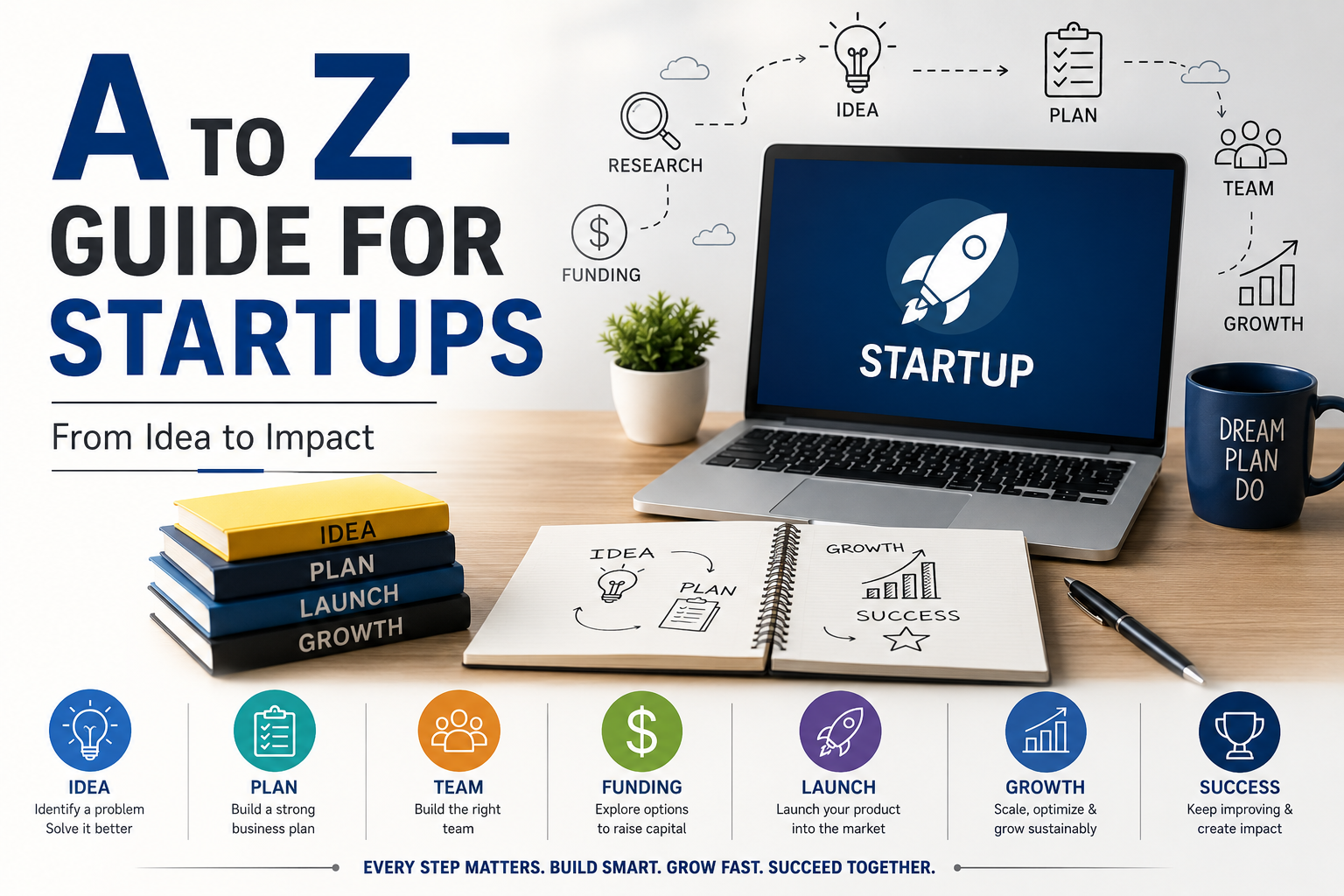
Build what world needs, Build in India
Over the period of decade, India’s startup ecosystem has witnessed extraordinary growth. From just a few hundred startups in 2016, India today has emerged as the world’s third-largest startup ecosystem, after the United States and China.
A – Assess the Market:
Before launching the start-up, entrepreneur must assess the market, this would cover various aspects such as Customer demand, competition analysis, pricing strategy, scalability, regulatory requirements, and technological trends.
Startups solving the real-world problems and AI driven with sustainability are keys to assess the market.
B- Business Status:
Choosing the best business structure is the most important and early decision, entrepreneur needs to make.
| Structure | Liability | Members (Min.) | Fund Raising |
| Private Limited | Limited | Min: 2 | Excellent |
| LLP | Limited | Min: 2 | Moderate |
| One person company | Limited | 1 | Limited |
| Partnership Firm | Unlimited | 2 | Difficult |
| Sole Proprietorship | Unlimited | 1 | Very Difficult |
C – Compliance:
Start up needs to have Comply with regulatory requirements. Startups need to do various filings such as ROC filings, Income Tax filings, GST filings, PF and ESI filings, Professional Tax filings, TDS filings.
Good corporate governance increases investor confidence and improves long-term sustainability.
D- DPIIT benefits:
Eligible start up need to obtain recognition with Department for Promotion of Industry and Internal Trade to avail various benefits, such as Income tax exemptions under Section 80-IAC, Faster patent processing with reduced fees, Access to government grants and incubators.
E-ESOP:
Employee Stock Option is the best tool to attract top talent without paying market salaries, and best tool to retain the top talent. It gives right to employees to purchase shares of the company at pre-determined price after vesting period.
F-Fund Raising:
Fund managing and raising is one of the most important aspects for any start up. Financial discipline is must for longevity. Sources of funding would be Bootstrapping (personal savings, family and small private investments), Angel Investors (High net worth Individuals etc), Crowd Funding, Venture Capitalist, Debt Funding, IPO.
G- Grants:
Start up can see the various grants which Central Government and respective State governments are giving for start-ups. Few schemes can be applied through Start up India, Digital India, Samridh, Atal Innovation Mission etc.
H-Human Resource:
Talent acquisition and talent retaining is the most important aspect of Human resources which start up needs to factor in. Start up can use various online tools to hire the best talent such as LinkedIn and can use ESOPs, flexible working models, performance incentive to retain the talent.
I-Intellectual Property Rights:
For startups involved in technology, software, research, branding, design, or content creation, Intellectual Property protection is crucial. Timely IP registration enhances business valuation and investor attractiveness. Intellectual Property rights include Patents, Trademarks, Copyrights etc.
J-Joint Ventures:
Getting into Joint Ventures can accelerate growth. Easy for market entry, technology access etc. However, governance, profit sharing, IP ownership must be clearly defined with clear exit.
K-Knowledge of Laws:
Knowledge about various laws is very critical for the success of start-ups, absence of not knowing law is no excuse. Start-ups must be aware about various and specific approvals and registrations needed – From RBI, SEBI, FSSAI, Income Tax, GST etc, implications of each law to the business must be known. Legal due diligence cannot be ignored.
L-Legal Documentation and Contracts:
Start-ups need solid legal foundation. This would protect the startups from possible legal disputes in future. Important documents include Shareholders agreements, Customer contracts, ESOP policies, Investor Agreements etc.
M- Marketing and branding:
Digital presence is very crucial today for success of any start-up. This includes – Website development, digital and social marketing, PR campaigns through influencers, LinkedIn marketing etc.
N-Networking:
Start ups should actively participate in various events, conferences, networking meets, trade associations. Networking often leads to mentorship, partnerships, and funding opportunities.
O-Operations:
Operational efficiency is the key for the success. Entrepreneur must optimize the operations through Automation, AI, Data analytics thereby trying to reduce the costs. Operational discipline directly impacts profitability.
P-Profitability and sustainability:
Investors value positive cash flow, revenue growth, sustainable growth. Start up should manage the cash burn and move towards profitability for longevity.
Q- Quality governance and customer satisfaction:
Start up like Zepta, Zerodha etc have focused on giving quality services to its customer. Customer satisfaction should be product feature. Startups need to prioritise reliability and uptime.
R-Revenue Model:
In India customers are price sensitive, each start up must decide on the revenue model which they would want, subscription, Commission, Product sales etc.
Pricing strategy must balance monetisation and mass adoption.
S-Scaling the business:
Scaling a startup in India requires much more than aggressive expansion. Investors and markets now prefer startups that can demonstrate sustainable growth, strong operational controls, positive unit economics, and customer retention.
T-Technology:
Indian startups are heavily investing in AI, Machine Learning, SaaS platforms, cybersecurity, fintech solutions, electric mobility, and deep-tech innovation. he rapid adoption of UPI, digital payments, cloud computing, and mobile internet has accelerated digital transformation across industries.
Fastest growing sectors:
| Sectors | Growth Potential |
| Artificial Intelligence | Very High |
| FinTech | Very High |
| Cloud Services | High |
| Clean Energy | High |
| Health | High |
| Agriculture | Moderate |
| Education | Moderate |
U-Unicorn:
India has more than 100 Unicorns, leading Indian unicorns such as Flipkart, Ola, Razorpay, Zepto, CRED, and Freshworks have demonstrated how Indian startups can scale globally through innovation and technology-driven business models.
V- Valuation:
Investors generally evaluate business scalability, founder capability, compliance status, revenue visibility, profitability, customer acquisition cost, and intellectual property ownership. Proper valuation planning is important because excessive dilution at an early stage may reduce founder control over the business. Valuation involves: Pitch Deck, Projections, Cap Table, Compliances – Due diligence, Business model and strategy.
W- Working Capital Management:
Cash is king, most start up dies because of no proper cash management, startups need to maintain at least 12-18 months of runaway all the time.
X- eXit Strategies:
Having a clear view of potential exits helps with strategic decisions throughout. Types of exits can be : IPO, Mergers and Acquisitions, Management Buyout etc.
Y-Your Ecosystem:
Certain Cities remain epicentre of few types of sectors.
Z-Zeal:
The success of a startup depends not only on funding but also on vision, execution, governance, and adaptability. Many startups fail because of weak financial discipline, lack of compliance, poor cash flow management, or unsustainable business models. Entrepreneurs who focus on innovation, customer trust, compliance, operational efficiency, and long-term sustainability are more likely to build enduring businesses.