
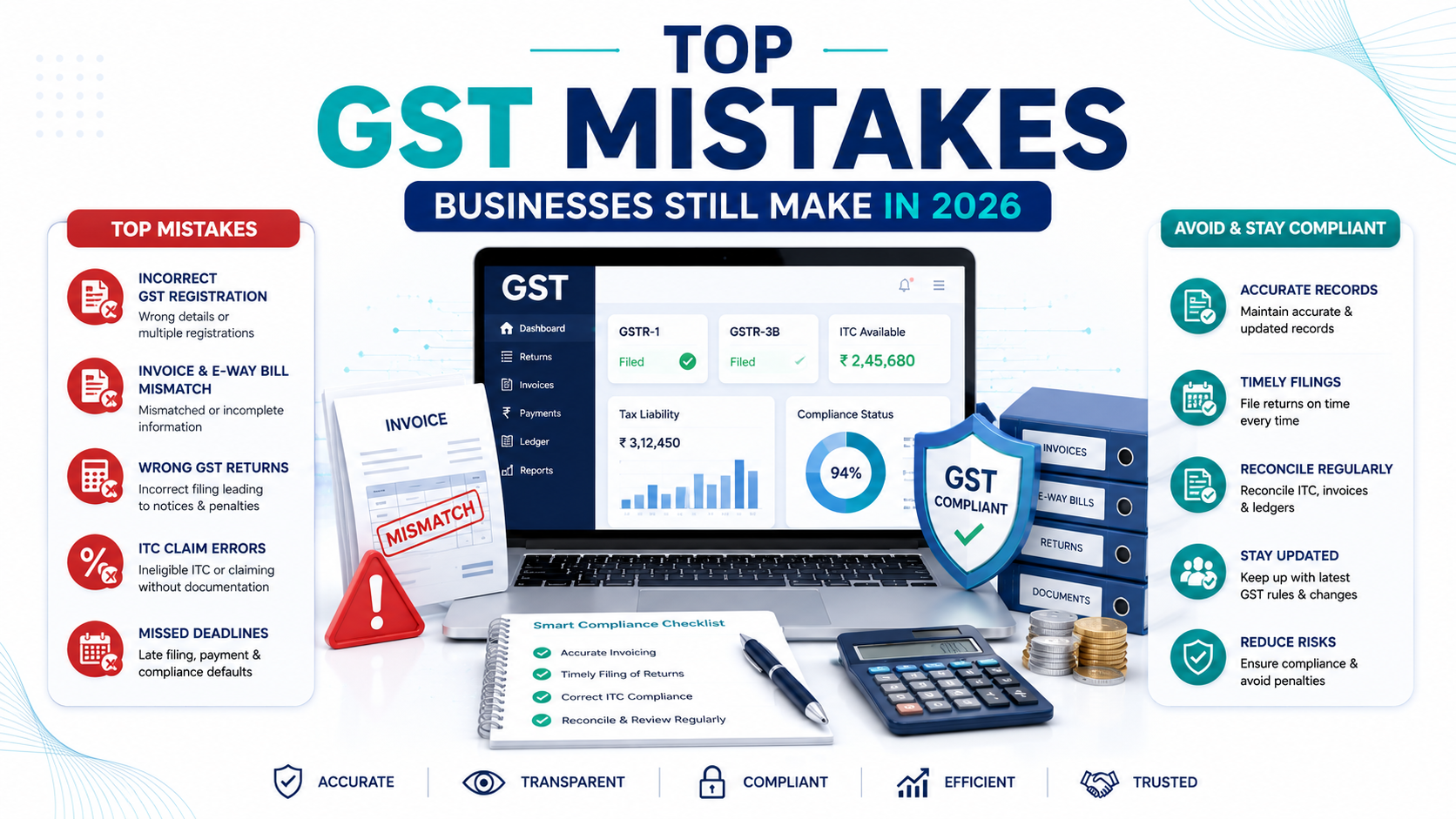
GST is in force for almost a decade now, but many businesses are making mistakes which are avoidable. Majority of disputes which are arising today is not due to tax evasion done intentionally but because compliance and documentation were overlooked.
Most common GST mistakes that businesses continue to make in 2026 and possible solutions to avoid them.
1. Claiming ITC Without Proper Reconciliation
Businesses still claim ITC based on purchase entries/invoices in their books without reconciling them with GSTR-2B. This is leading to departmental notices and denial of credit.
Best Practice:
Perform a monthly reconciliation of Purchase/Input Register, GSTR-2B, GSTR-3B confirmations before filing returns.
2. Ignoring Vendor Compliance
Off late GST officers are sending notices, if vendors who fail to file returns, cancel registrations, or issue incorrect invoices this can significantly affect your ITC.
Best Practice:
Monitor vendor compliance regularly, visit vendor premises, maintain a vendor rating system based on GST performance.
3. Delaying Reversal and Reclaim of ITC
It is noted that taxpayers either fail to reverse ITC which they are not eligible to claim or forget to reclaim it after the conditions are satisfied.
Best Practice:
Maintain a separate tracker for all ITC reversals and eligible reclaims so that no legitimate credit is lost.
4. Poor Documentation
Invoices, e-way bills, transport documents, delivery challans, purchase orders, and payment proofs are often incomplete or missing when scrutiny begins. Most of the demand created by GST officers are due to lack of proper documentation.
Best Practice:
Proper documentation is the only defence during any GST audit or investigation.
5.Ignoring GST Reconciliations Until Year-End
Accounts team often postpones the reconciliation until annual return filing, making it difficult to identify and correct errors.
Best Practice:
Carry out monthly reconciliations between books, GSTR-1, GSTR-3B, GSTR-2B, e-way bills, and e-invoices.
6. Assuming Every Expense Is Eligible for ITC
ITC continues to be claimed on blocked credits such as certain employee benefits, motor vehicles, club memberships, Insurance and other restricted input.
Best Practice:
Always review list of ineligible Input tax credit in Section 17(5) before claiming ITC on any expense.
7. Responding Late to GST Notices
Many businesses ignore notices assuming they can respond later or many times notices lists are not seen at all, missing statutory timelines can result in adverse orders even when the taxpayer has a strong case.
Best Practice:
Create an internal process to monitor GST notices (keep a check on mails, gst portal) and respond within the prescribed time along with complete supporting documents. Avoid last minute submissions.
8.Treating GST as a Compliance Function Instead of a Business Function
GST impacts procurement, sales, finance, logistics, contracts, pricing, ERP systems, and cash flow. Treating it as the responsibility of only the accounts department will lead to non-compliance quite often.
Best Practice:
Build cross-functional awareness so that GST considerations are part of every major business decision.
Final Thoughts
The GST Department is increasingly using data analytics, return matching, e-invoice data, e-way bill information, and AI-driven risk assessment to identify mismatches. Businesses that rely only on year-end corrections may find themselves facing unnecessary notices and litigation.
The good news is that most GST disputes can be prevented through timely reconciliations, robust documentation, periodic internal reviews, and proactive compliance.