
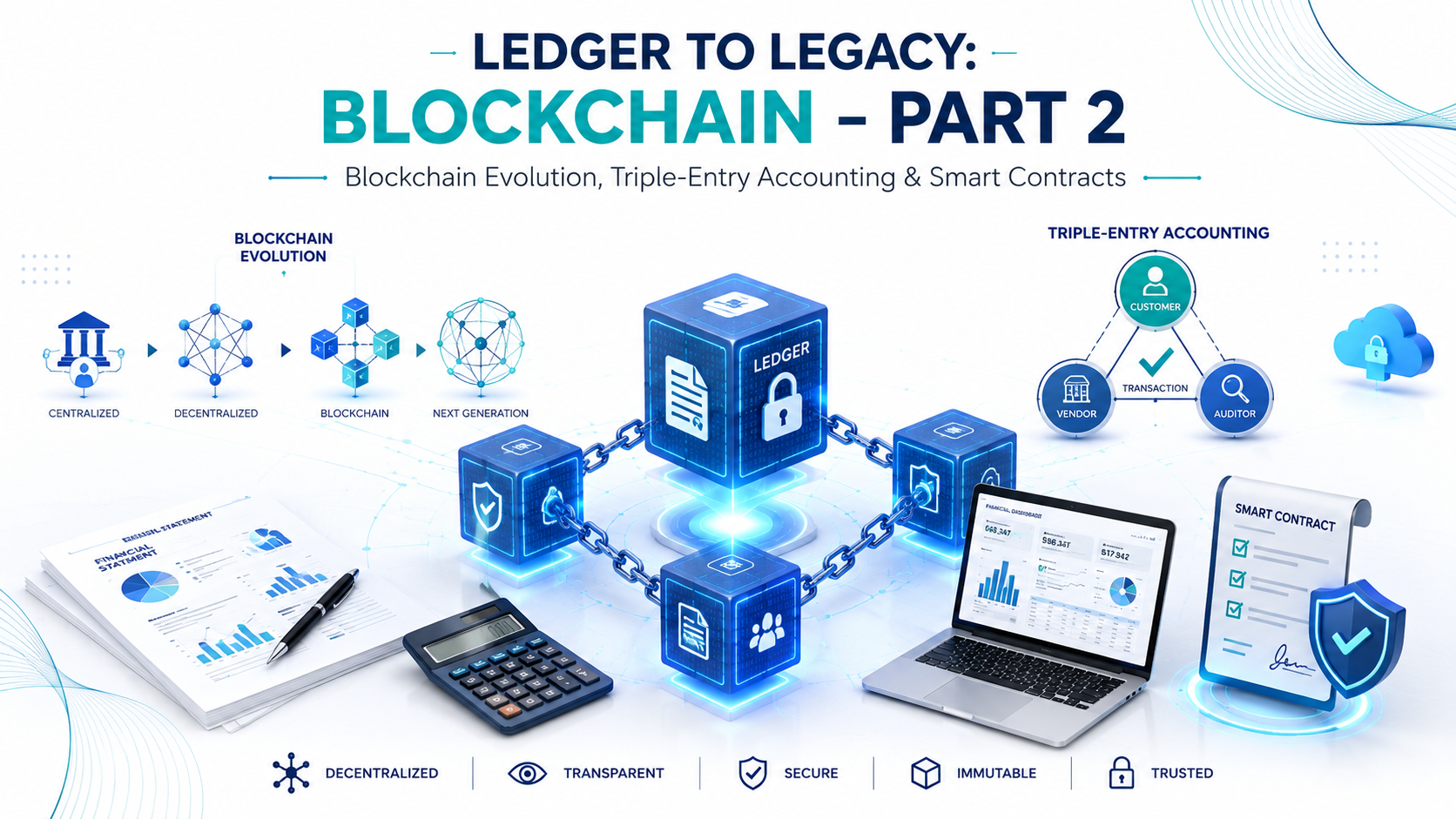
Blockchain and Evolution of Accounting
From Double-Entry to Triple-Entry Accounting
Traditional bookkeeping uses double-entry accounting: every transaction is recorded twice, once as a debit and once as a credit, in two separate ledgers (the buyer’s books and the seller’s books). The problem is that both parties keep their own private records, so there’s always a possibility of error, disagreement, or fraud, since nothing forces the two ledgers to match.
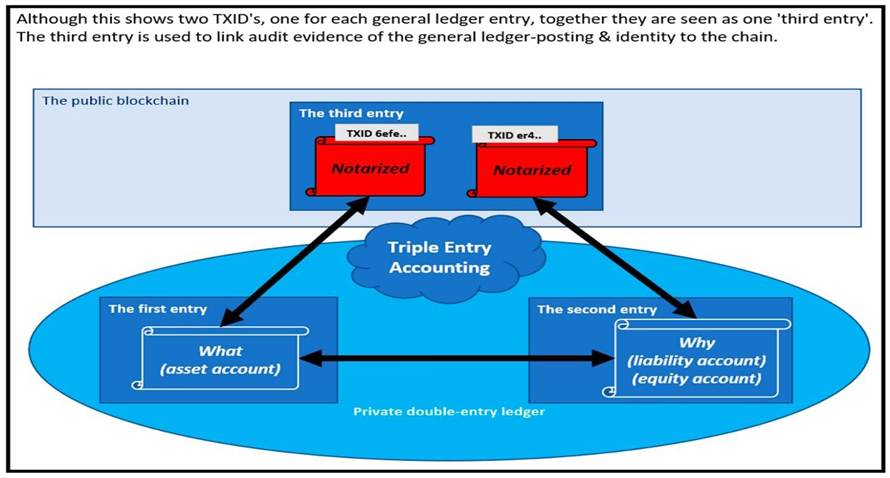
Triple-entry accounting adds a third entry: a shared, cryptographically secured record on a blockchain that both parties (and the network) can independently verify. Instead of trusting each other’s private books, both sides point to the same tamper-proof entry as the single source of truth.
Example
Imagine Company A sells goods worth ₹50,000 to Company B.
In double-entry accounting:
- Company A records: “Sold goods, ₹50,000 credited to Sales, debited to Accounts Receivable.”
- Company B records separately: “Purchased goods, ₹50,000 debited to Inventory, credited to Accounts Payable.”
These are two independent entries in two separate systems. If Company A later disputes the amount, or an auditor wants proof, someone has to manually cross-check both companies’ books, which takes time and relies on trust.
In triple-entry accounting:
- Company A records the sale.
- Company B records the purchase.
- A third entry is automatically created on a shared blockchain ledger, cryptographically signed by both parties, timestamped, and linked to the previous transaction history.
This third entry acts like a digital receipt that both companies and any authorized auditor can verify instantly, without needing to compare two separate private ledgers. Because it’s secured with cryptographic hashes, neither party can alter it after the fact without the change being detected.
Real-Time Accounting
One of the most significant advantages of blockchain is real-time transaction recording. Instead of waiting for month-end reconciliations, stakeholders can access verified transaction data instantly.
This capability enables:
- Faster financial reporting
- Improved decision-making
- Continuous monitoring of transactions
- Reduced reconciliation efforts
Enhanced Transparency
Every authorized participant in the blockchain network can view the same transaction history. This creates a single source of truth, reducing inconsistencies and improving confidence in financial information.
Smart Contracts: The Next Frontier
A smart contract is a self-executing digital agreement stored on a blockchain. Once predefined conditions are met, the contract automatically performs the agreed action.
Example:
- Vendor payments can be released automatically upon delivery confirmation.
- Loan repayments can be triggered on scheduled dates.
- Insurance claims can be processed automatically upon verification of specific events.
Smart contracts reduce manual intervention, increase efficiency, and minimize the risk of errors and fraud.

You’ve discovered how blockchain is revolutionizing accounting through triple-entry accounting, real-time record-keeping, smart contracts, and greater transparency.
In Part 3, we’ll examine how blockchain is reshaping the accounting and auditing profession, improving audit efficiency, reducing reconciliation efforts, strengthening fraud prevention, and how it compares with traditional accounting software like Tally, SAP, and Zoho.
Continue Reading →
Ledger to Legacy: Blockchain – Part 3 | Blockchain in Accounting, Auditing & Enterprise Systems