
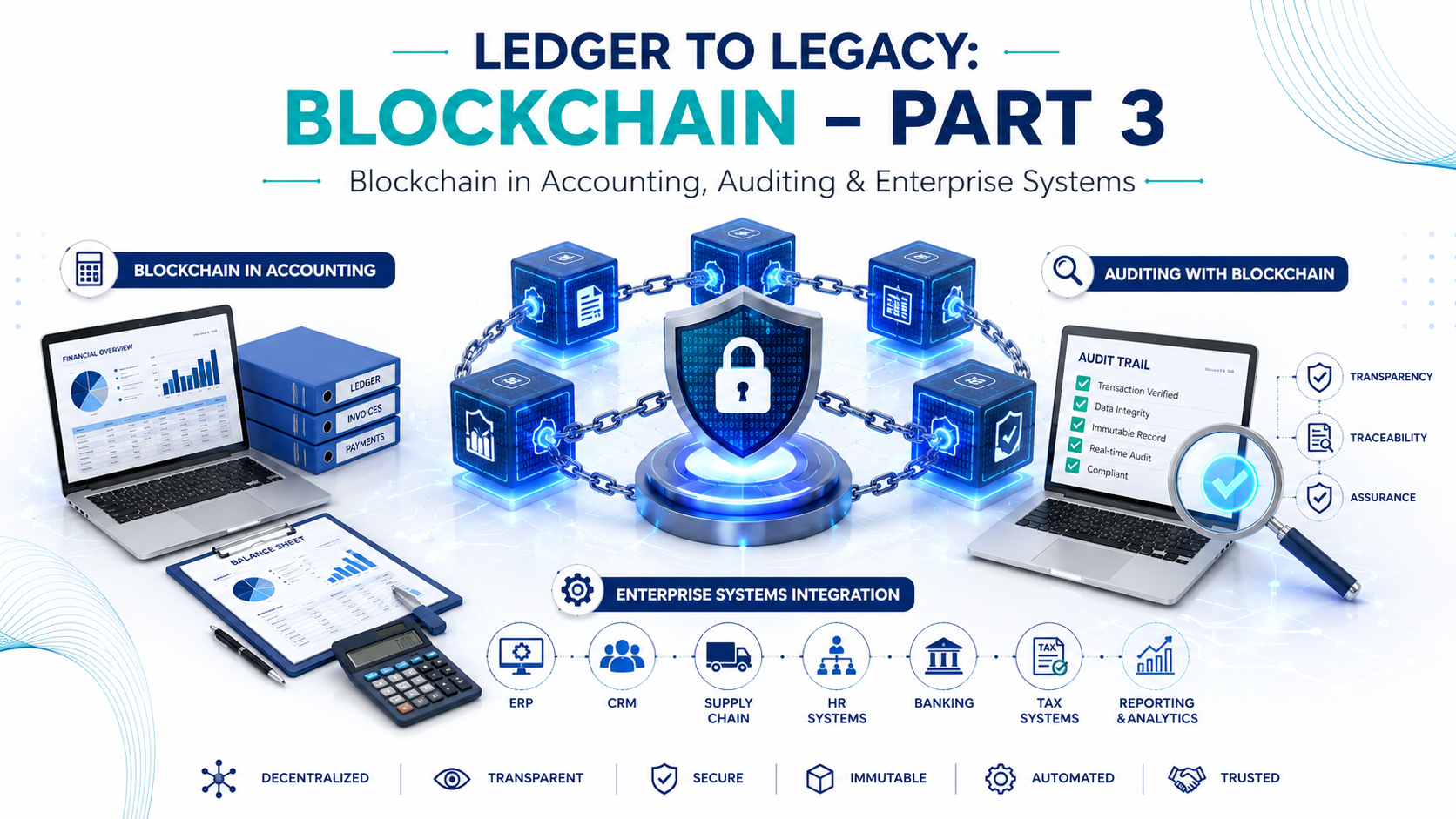
Blockchain in the Accounting and Auditing Profession
Accounting and auditing have historically relied on trust, manual reconciliation, and after-the-fact verification. Blockchain technology is changing that by offering a shared, tamper-resistant record that multiple parties can rely on simultaneously. Here’s how it’s reshaping the profession.
Real-time, verifiable record-keeping:
Instead of each party maintaining separate books that need to be reconciled later, blockchain allows transactions to be recorded once on a shared ledger that all relevant parties can access. As discussed with triple-entry accounting, this means a sale, payment, or transfer is verified and timestamped at the moment it happens, rather than being confirmed weeks later during an audit.
Reduced need for manual reconciliation:
A large portion of an accountant’s time traditionally goes into matching invoices, bank statements, and internal records that were created independently. When transactions are recorded on a blockchain, both parties are working from the same verified entry, so there’s far less need to chase down discrepancies between two sets of books.
Continuous and more efficient audits:
Auditors traditionally sample transactions and verify them after the fact, often months after they occurred. With blockchain, auditors can potentially access a real-time, immutable trail of transactions, enabling continuous auditing rather than periodic checks. This shifts the auditor’s role from verifying that records weren’t tampered with, toward analyzing patterns, risks, and the substance behind transactions.
Smart contracts automating routine accounting tasks:
Smart contracts are self-executing pieces of code on a blockchain that automatically carry out actions when predefined conditions are met. For example, a smart contract could automatically release payment once a shipment is confirmed as delivered, then record both the payment and the triggering event on the blockchain at once. This reduces manual data entry and the errors that come with it.
Stronger fraud prevention:
Because blockchain entries are cryptographically linked and nearly impossible to alter without detection, blockchain makes it significantly harder to backdate transactions, double-count revenue, or quietly delete records, all common methods of financial statement fraud.
Challenges the profession still faces:
Blockchain isn’t a complete replacement for accounting judgment. Auditors still need to verify that what’s recorded on chain reflects real economic activity (a blockchain can faithfully record a fraudulent transaction just as easily as a legitimate one). Other challenges include integration with existing legacy accounting systems, unclear or evolving regulatory and tax treatment of blockchain-based transactions, the technical skills gap, since many accountants and auditors still need training in blockchain and cryptography, and privacy concerns when using public blockchains for sensitive financial data (often addressed using the permissioned and cryptographic techniques discussed earlier).
The likely future:
Rather than replacing accountants, blockchain is more likely to shift their role from record-keepers and reconcilers toward analysts, risk assessors, and interpreters of blockchain data. Routine verification work becomes automated, while professional judgment becomes more valuable in assessing the substance, risk, and context behind transactions.
Blockchain vs Tally, SAP, and Zoho: Can It Replace Accounting Software?
Before comparing, it’s worth being clear about something important: blockchain is not a like-for-like replacement for Tally, SAP, or Zoho. These are accounting software that manages a single organization’s books. Blockchain is a shared record-keeping technology for transactions between multiple parties. The honest comparison is about what each one is good at, not which one “wins.”
A simple comparison
| Aspect | Tally / SAP / Zoho | Blockchain |
| Who it serves | One organization’s internal books | Multiple parties sharing a transaction |
| Trust model | Each party trusts its own software | Trust is built into the shared ledger itself |
| Reconciliation | Manual, after the fact | Largely unnecessary; both sides see the same entry |
| Tampering risk | Possible (internal access, errors) | Extremely difficult once recorded |
| Tax/compliance filing | Built-in, mature, India-ready | Not built for this; needs integration |
| Ease of use for accountants | High, familiar interface | Low currently; needs new skills |
| Cost and maturity | Established, affordable, supported | Still emerging, integration costs are real |
Can blockchain replace them?
Not on its own, and not soon. What’s more realistic, and already happening, is integration rather than replacement: a business continues using Tally, SAP, or Zoho for its day-to-day bookkeeping, tax filing, and reporting, while blockchain operates underneath or alongside it to verify specific high-trust transactions, such as inter-company transfers, supply chain payments, or audit trails, between organizations that don’t fully trust each other.
Think of it less as “blockchain replacing Tally” and more as “blockchain handling the parts of accounting that involve two or more parties, while Tally and SAP continue handling the parts that involve one.” The meaningful insight
Software like Tally and SAP answer the question “what does our business record show?” Blockchain answers a different question: “can an outside party trust that this record is true without taking our word for it?” Most businesses need both. The real future isn’t blockchain replacing accounting software, it’s accounting software increasingly plugging into blockchain networks for the specific transactions where mutual trust and tamper-proof verification genuinely matter.
Role of Chartered Accountants in a Tech-Driven Blockchain World
As blockchain technology moves from experimentation to mainstream adoption in finance, the role of the Chartered Accountant (CA) is shifting significantly. Rather than becoming obsolete, the profession is evolving to take on new responsibilities that blockchain itself cannot perform.
From record-keeper to record-validator
Historically, a large part of a CA’s work involved creating, checking, and reconciling financial records. With blockchain automatically maintaining a shared, tamper-resistant ledger (as seen in triple-entry accounting), much of that manual record-keeping is reduced. The CA’s role shifts from producing the numbers to validating whether the numbers reflect genuine, lawful, and properly classified economic activity. A blockchain can confirm that a transaction happened and wasn’t altered, but it cannot judge whether that transaction was appropriate, correctly valued, or compliant with accounting standards. That judgment remains squarely a human, professional responsibility.
Skills CAs will need going forward
To stay relevant, CAs will need to build literacy in blockchain architecture and cryptographic principles, develop familiarity with smart contract platforms and their accounting implications, strengthen data analytics capabilities, since blockchain generates large volumes of verifiable data, and stay current on the evolving regulatory and tax treatment of digital assets and crypto-transactions.
Future of the profession
Blockchain is unlikely to replace CAs, but it will replace the parts of their work that are purely mechanical: data entry, reconciliation, and basic verification. What remains, and grows in importance, is everything that requires judgment: interpreting whether transactions reflect real economic substance, assessing risk in increasingly automated systems, advising businesses on adopting new technology responsibly, and providing assurance that complex, automated financial systems are trustworthy.
In this sense, the CA’s role moves up the value chain, from checking the past to providing real-time assurance and forward-looking advisory, with blockchain handling the routine verification work that once consumed much of the profession’s time.
Challenges and Limitations
Despite its potential, blockchain adoption faces several challenges:
- Regulatory uncertainty
- Data privacy concerns
- High implementation costs
- Integration with legacy systems
- Cybersecurity risks
- Skill gaps among professionals
Organizations must carefully evaluate these factors before implementing blockchain-based solutions.
Blockchain solves the “did the two parties agree, and was the record altered later” problem extremely well. It does almost nothing to solve the “are these two parties acting in good faith” problem, which is precisely the kind of problem, related-party fraud represents. It is an honest point to include because it pushes back on blockchain hype and reinforces why professional skepticism, audit judgment, and regulatory oversight remain irreplaceable even in a blockchain-driven world.
What’s Next?
You’ve explored blockchain’s impact on accounting, auditing, enterprise systems, and how it complements traditional accounting software rather than replacing it.
In Part 4, we’ll look at the future role of Chartered Accountants, the challenges of blockchain adoption, real-world enterprise implementation, and how global organizations are leveraging blockchain to drive innovation and digital transformation.
Continue Reading →
Ledger to Legacy: Blockchain – Part 4 | Future of Chartered Accountants & Enterprise Blockchain Adoption